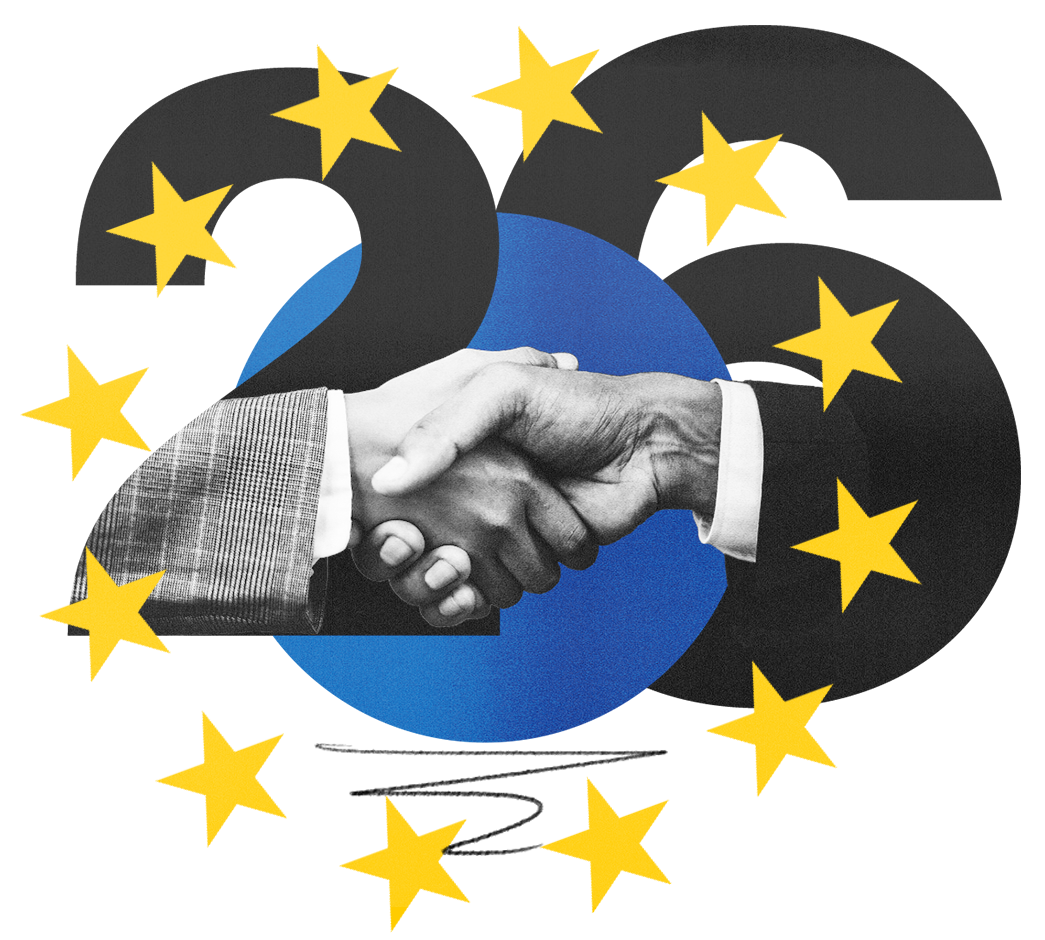
Welcome to the Common Good Guide to the Irish EU Presidency.
Most of what you will read about the upcoming Irish EU Presidency will tell you it is a big deal.
We are here to tell you what to actually do about it.
Andrea Pappin has worked on two Irish Presidencies, in 2004 with the Department of Foreign Affairs (who led that Presidency at the time) and as Official Spokesperson in the Department of the Taoiseach, for the last Presidency in 2013. She has been in the rooms, chaired the briefings and navigated the politics. She’s got a fairly good idea of what that means in practice.
The Presidency is now underway. The official programme is live at ireland2026.eu. This guide is our practical layer on top of that which we hope helps.
The questions we think you are probably asking yourself…
-
Now that the Presidency is up and running, here are our seven tips for businesses and organisations to support this Presidency and make the most out of it.
1. Watch the Presidency website and comms channels — there is more there than is reported
The official Irish Presidency website is now live and is the go-to reference for the next six months. It houses the event calendar, the policy programme and official information as it is released.
Most of what appears there will not be picked up by general media - so if you are only following the news, you are missing things. Also useful to follow them on LinkedIn and on other media channels.
2. Build your communications around the Presidency priorities — you are heard more when you speak Presidency
Competitiveness, Security and Values are the three themes everything is organised around. If your organisation's issues connect to any of these - and most do - align your language and your asks to the Government's framework. You do not need to pretend the connection exists if it does not. But where it does, make it explicit. You are heard more when you are speaking the same language as the Government people doing the work.
3. Make friends with the civil servants, not just the Minister — they are doing the thankless work
Every Department has a core Presidency team covering policy, logistics and communications. These are the people who will be in the room, supporting the events, and co-ordinating the legislation. Find out who covers your area — search Who Does What on gov.ie. The Minister is important but the civil servant is often more so. That is not a criticism of Ministers, it is just how this works. It’s also important to stress that Irish Civil Servants have effectively had their jobs doubled with no additional pay for this work - something to think about!
4. Leverage your rep groups, trade associations and Brussels teams — they have the access
Your industry body, trade association or sector rep group has been engaged with the Government on the Presidency since long before July. They know the relevant officials, they may have associated events planned, they have Brussels contacts. Talk to them. If there is a European-level federation or body for your sector, make sure your Irish team is plugged in. And if there is one organisation worth signing up to as an individual or an organisation, European Movement Ireland is worth a look — serious expertise, genuine access and useful events throughout the Presidency. (There’s even more about what organisations to approach further down in this guide so keep reading).
And whoever you are approaching, come with a good ask - if you are doing business in Spain, know that every Spanish Minister will be in town. See about getting an extra added to their programme - a breakfast meeting, a tour of a site - whatever is realistic. Be clear in what you are asking for.
5. Know your Associated Events and Cultural Programme — and get involved
As mentioned above, Associated Events are not official Government events — they are run by representative organisations, trade bodies, academic institutions and civil society groups, and are recognised in the official Presidency Calendar. Check what your industry group or sector body has planned. If they have an event, find out who they are inviting and whether you can attend, speak or support it.
6. Come with solutions, not just positions — be specific, find the text, suggest the language
Do not go to a Department and say you want more focus on competitiveness. Find the actual legislative text that affects your organisation, identify the specific provision, suggest alternative language and argue your case clearly. That is how influence works in the EU system. Vague positions are forgettable. Specific, well-evidenced proposals get heard. The people on the other side of the table are working through thousands of files — make their job easier, not harder.
7. Do not forget the domestic agenda — this can be a great time to keep those conversations advancing
Irish Government business does not stop because the Presidency has started. Ministers and officials are stretched over these six months. That makes it a surprisingly good time to keep your domestic policy conversations moving — not a reason to pause them. The temptation is to assume everyone is focused on Brussels. They are not. The domestic agenda still needs to advance and the people working on it still need input from organisations like yours.
-
Every six months, one of the 27 EU Member States takes the chair. For those six months, that country leads every single meeting at every level of the Council of the EU, from Ministers negotiating headline legislation down to civil servants ironing out the technical details. We are talking about close to 2,500 meetings in total in Dublin and Brussels.
The agreed approach to this role is to be an 'honest broker' and this genuinely matters. Ireland really will be at the centre of key European decision making for six months. Now, we’re not there to bully our pet issues onto the agenda. We are there to find compromise, keep things moving and get the business of the EU done. That said, there is plenty of room for Ireland to influence: how things are ordered on an agenda, which events you choose to host, who gets a platform. The subtleties add up.
One honest caveat worth stating upfront: most of what a Presidency does will not land on your doorstep anytime soon. The bulk of the work is highly technical legislation that, even if agreed during our six months, may not take effect for years. The EU does not do fast. What the Presidency does do is keep an enormous, complex machine moving — and with a brief this wide, covering everything from fisheries quotas to AI regulation, our Civil Service will be earning their salaries several times over between July and December.
Ireland is known for running good Presidencies. Effective, well-organised, good at finding compromise. Eight Presidencies in and we have never really had a bad one, which can become a self-fulfilling prophecy. That is either reassuring or terrifying depending on how you look at it.
-
A quick crash course. The EU has three main institutions doing the heavy lifting on legislation. EU wonks, please do tell me where I've got this wrong — this is deliberately high-level:
The Commission devises legislation. Think of it as the EU's civil service, staffed by people who are meant to transcend their national identities and work in the interests of Europe as a whole. They have a permanent President who leads this institution.
The Parliament on behalf of citizens, refines and for a lot of legislation now needs to approve it alongside the Council. The Parliament also has a permanent President, voted by the MEPs.
The Council where countries are very much representing their national interests, is the real powerhouse of decision-making. To be blunt: nothing happens until the Council agrees to it. The Parliament folk won't love that description, but the honest truth is that while they are involved in a lot of legislation, the Council is involved in all of it. Presidency of the Council meetings rotates every six months to another EU Country’s Government to run it.
It is this last institution that Ireland chairs from 1 July to 31 December. The name is a bit of a red herring because it is not really one Council, it is in fact ten Councils, organised by policy theme. Everything from farming and fisheries to foreign affairs and finance - you can read all about them here. Sheep to satellites, essentially. Each Council is chaired by the relevant Irish Minister, so across our six months many members of Cabinet will get their moment at the European table. And when the Taoiseach convenes his counterparts, that one is called the European Council.
Beneath those ministerial meetings sits a whole architecture of preparatory work - of course it does, it is the EU. Two layers worth knowing about:
Civil servant meetings. In Brussels, there are a huge volume of civil servant meetings getting legislation into shape before it reaches their Ministers. Irish officials chair all of these. Our Ambassador to the EU, Aingeal O'Donoghue, plays a central role, as do senior officials across our Brussels office, the Permanent Representation (or Perm Rep to its friends). The volume of these meetings is something to behold. For each piece of legislation, you are managing 26 other national positions alongside your own, with knock-on effects across multiple files simultaneously. Think 3D chess, played at speed, with 27 players across countless legislative chess boards.
Informal Council meetings. Informal Council meetings, usually held in the Presidency country. These are where a Presidency gets to add some of its own flavour — new issues, particular priorities, a chance to show the country off.
For all the information about all the Presidency events, check out the Irish EU Presidency’s website here.
-
Most of the work happens in Brussels. That is where the meetings are, where the deals get done and where Ireland has significantly beefed up its team to cope with the volume of work.
That said, there is a meaningful calendar of events on Irish soil. The Government has confirmed around 270 meetings involving Ministers and officials across Ireland over the six months, including 22 Ministerial Informals. There are also some headline events: an AI Summit in Dublin in October, the European Political Community meeting in Dublin in November and a European Council meeting later in the year.
The full cadence of key official meetings runs from June through to December, covering everything from Environment and Agriculture to Finance and Foreign Affairs.
And in addition to all the legislative meetings and Ministerial events, it’s also useful to be aware of Associated Events. These are events run by representative organisations and interest groups that are not “Government official”, but which the Government recognises in the Presidency Calendar as they help amplify the themes.
For the full list of Presidency meetings and Associated Events in Brussels and across Ireland, check out the Irish EU Presidency’s website here.
-
The Department of Foreign Affairs and Trade is the lead Department this time around. In 2004 it was Foreign Affairs, in 2013 it was the Department of the Taoiseach, and now we are back to Foreign Affairs. Their officials chair all the internal Government coordination meetings — so they are always a good starting point when navigating the system. That said, this work is done in very close collaboration with the Department of the Taoiseach. Not much happens without the Taoiseach's team being across it.
Each Department has its own core Presidency team covering policy, logistics and communications. You can find out who covers your area by searching Who Does What on gov.ie.
Government coordination in Dublin runs through two substantial committees with representatives from all Departments and major agencies:
The Operations Committee (IDGOPP). The event management engine room. With 22 Informals happening across the country — not to mention the European Political Community in November — the logistics are extraordinary. This is the team handling procurement and event delivery, making sure everything runs to the standard these occasions demand.
The Policy Committee (IDGPPP). Meets regularly to get updates from the Brussels Permanent Representative team on where legislation stands — what is moving, what is stuck, what is heading to Trilogue. These are the people building the policy agenda that Ministers are working from.
There is also a High Level Group on EU Policy (HLGEUP) and an Interdepartmental Group on Culture leading on the Presidency Cultural Programme. Good to know they exist.
Communications are being coordinated centrally by the Department of Foreign Affairs and Trade in collaboration with the Government Information Service, with all key Departments and agencies linking in.
The people named in newspaper articles are not always going to be the ones taking your call. Knowing the broader structure and finding the right person at the right level for your issue is half the battle.
P.S. If you are itching to know what those acronyms stand for: IDGOPP is the Interdepartmental Group on Operational Presidency Planning and IDGPPP is the Interdepartmental Group on Policy Presidency Planning. Just make sure you do not get your OPPs mixed up with your PPPs.
-
Not quite. Every Presidency is shaped by its moment, and EU2026 has a few things that make it genuinely distinctive.
The most obvious is timing. Ireland normally holds January to June Presidencies. This is our first in the second half of the year — a H2 as it is known. That sounds like a nerdy distinction, and it is, but it has real consequences. August is the sacred political break. September pulls a lot of attention to New York for the UN General Assembly. December disappears into Christmas. In practice, you are working with four and a half effective months rather than six. The calendar compresses quickly.
Ireland is also the first country in the next Trio of Presidencies, grouping us with Lithuania and Greece. The Trio structure exists to give some coherence between consecutive Presidencies rather than having things lurch from one set of priorities to the next every six months. Great that we’re the first of this Trio - that’s considered one of the stronger positions to have in a Trio. This is our first Presidency without the UK in the room, which will be an interesting dynamic in its own right.
Then there is the political climate, which shapes everything. In 2004, Ireland hosted at the height of the Celtic Tiger, with the extraordinary privilege of welcoming ten new Member States into the EU. Events right across the country, a genuine moment of European optimism. In 2013, the context was entirely different. Ireland was in an IMF programme, fiscal discipline was not optional, and the Presidency was run accordingly — every penny accounted for, every decision scrutinised. We had to demonstrate that we were serious Europeans while being careful not to be seen spending money on Eurocrats when the public finances were under the microscope. And we did it. Ireland delivered a highly effective Presidency in genuinely difficult circumstances, which is worth remembering next time someone implies this is easy.
EU2026 sits in a different place again — neither boom nor austerity, but with its own pressures regarding security, competitiveness and values (hence the themes eh?). The Cyprus Presidency did have to curtail some of its planned programme due to the situation in the Middle East, which meant the Irish Presidency has begun with heightened attention from European leaders keen to gather and have broader conversations.
-
Competitiveness, Security and Values are the three headline themes for the Irish Presidency. They are large buckets by design. The EU's legislative agenda covers everything from agricultural subsidies to artificial intelligence, so you need themes broad enough to accommodate all of it without collapsing into meaninglessness.
Security. This is a significant brief for a traditionally neutral country to chair at a moment when defence spending and border security dominate the European conversation. Worth watching carefully.
Competitiveness. Ireland's home ground. The decision to host a major AI Summit in Dublin in October is not an accident. The One Europe, One Market Roadmap, agreed by all three institutions, sets the agenda here — simplification, single market deepening, digital transformation. This is where Ireland wants to lead.
Values. A broad bucket, but an increasingly important one. Online safety for children is a concrete priority. Rule of law, democracy and European values are more relevant now than they have been for a generation.
The one file everyone should know about regardless of sector: the Multiannual Financial Framework. The EU's long-term budget for 2028 to 2034. Ireland's job is not to close it — that is a job for the European Council — but to advance the negotiations significantly and hand over a sufficiently developed negotiating box by December. Every sector is touched by that budget. If your organisation does not know where it sits in the MFF negotiating text, now is the time to find out.
-
The most useful thing you can do is identify which organisations — Irish and European — are most relevant to your issues during the Presidency.
Irish organisations
Most sectors have an umbrella body. Banking has the Banking and Payments Federation, business broadly has Ibec, and so on. Your sector almost certainly has one — finding it and talking to them is the first step.
If you are coming at this fairly fresh, get your hands on an old IPA Yearbook and Diary. They paused production in 2024 but older editions remain genuinely useful — they list virtually every organisation and not-for-profit in the country. Most of the information is still current.
The Irish Lobbying Register is also worth a trawl if you want to see who is actively engaging on your issues.
European organisations
Three resources worth knowing about for the Brussels landscape:
The EU Transparency Register. Free and public. It is a bit of a dig but the information is there.
Dods EPAD. The trusted Brussels bible, now online. Requires a paid subscription but is comprehensive.
Best in Brussels. A free online guide focused on consultancies and law firms — useful if you are looking for professional support on the ground.
Embassy contacts
If you have business across the EU, keep your embassy contacts up to date — both international embassies here in Ireland and the Irish team across Europe. Ministerial delegations from every EU member state will be passing through Ireland over these six months. Your embassy contacts, both here and abroad, are your best source of information on travel plans and access opportunities.